

































下载地址
https://www.zhengdianxue.com/wp-content/uploads/skills/yunxin-ai--workflow-insight-mapper.zip将提示词发送给你的 AI 安装该 skills
请根据 https://skillhub.cn/install/skillhub.md,安装 @yunxin-ai/workflow-insight-mapper。从模糊想法、业务经验和已有材料中帮你梳理和提炼思维框架/业务流程/方法论体系,生成带证据边界与安全停止的动态交互式 HTML 流程图。适合审批、交付、排查、复盘和团队 SOP
阅读全文 (展开查看完整说明)
概述
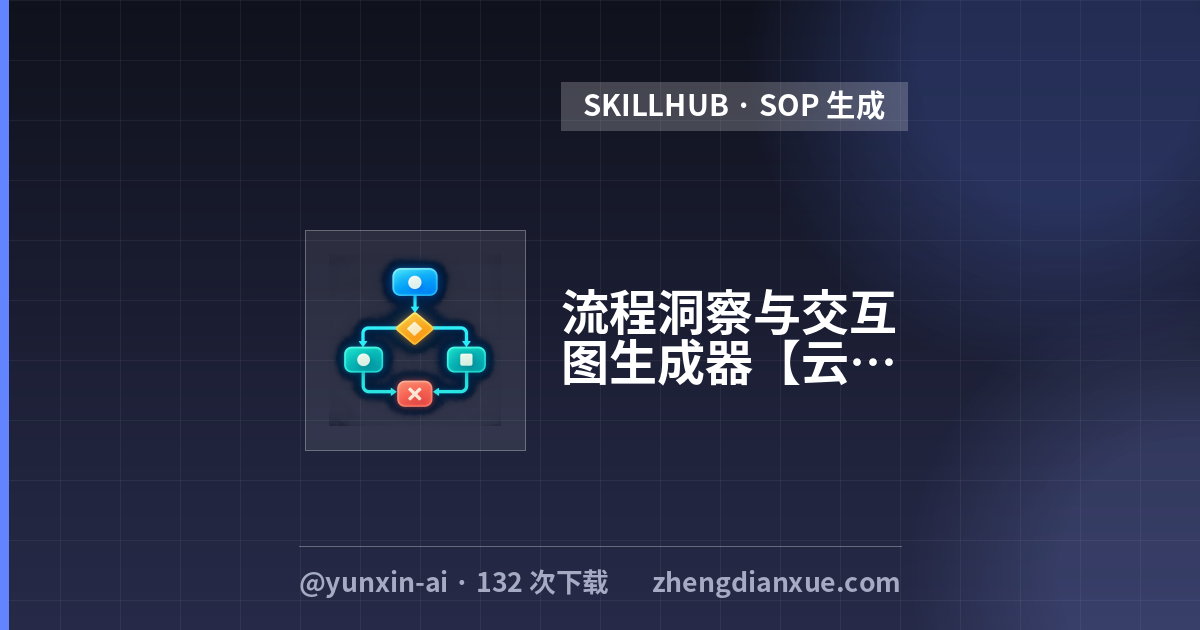
流程洞察与交互图|Workflow Insight Mapper
你只要说出目标、粗略步骤,或者一段藏在脑中的工作经验,它会帮你把流程问清楚、把关键判断和例外找出来,再生成一张可以点击查看的 HTML 流程图。
能帮你做什么
- 把“我平时就是这么做的”整理成清楚的步骤、判断标准和停止条件;
- 找出流程里容易遗漏的输入、审批、返工、例外和风险门禁;
- 把已经说清楚的流程生成可独立打开的交互式 HTML 图,方便讲解、复盘和交接。
适合什么时候用
- 梳理审批、交付、排查、复盘和团队 SOP;
- 提炼个人或团队的隐性经验,形成可复用的方法;
- 把 Skill、Agent、项目计划或业务流程变成容易讨论的可视化材料。
可以这样开始
- “我有一段审批流程,但说不清每一步怎么判断,帮我问清楚并画出来。”
- “把这份 SOP 整理成可点击的流程图,标出返工和安全停止。”
- “根据这段业务经验,找出关键决策,再生成 HTML 流程图。”
Agent 负责和你对话、追问、修订与确认;这个 Skill 负责把确认后的内容编译、校验并呈现出来。它不在页面里内置聊天或直接编辑器。
Create an evidence-bounded, desktop-readable workflow diagram with one obvious path, explicit user interactions, and visible evaluation gates. For vague or experience-centered requests, first run a lightweight, one-question-at-a-time discovery conversation and compile its structured bundle into the diagram. This skill is self-contained: use only the local references and scripts/diagram.mjs, which invokes the bundled engine under runtime/diagram-engine. Do not make the external Nuwa folder or another diagram skill a runtime dependency.
Modes
Choose one mode before authoring:
render: the user already supplied a sufficiently concrete process or workflow JSON;elicit: mine a user's personal, team, or business experience from real events, materials, or a live task;refine: review an existing diagram, identify unsupported or missing decisions, and propose a structured revision;audit: inspect an existing workflow artifact without changing it.
Use elicit when the request contains a vague goal, an abstract principle, or phrases such as “帮我梳理经验/思维/业务流程”. Use render when the user has already supplied steps, roles, inputs, outputs, conditions, and exceptions. Do not silently turn elicit into external research or a personality/voice simulation.
Required Outcome
Deliver:
- a schema-v2 Archify workflow JSON;
- a self-contained interactive HTML viewer;
- a validation receipt;
- visual-check evidence and a truthful visual-review status.
The diagram must explain both:
- what happens at each stage;
- how that stage is judged, approved, stopped, or allowed to continue.
Workflow
- Select
render,elicit,refine, oraudit. - For
elicitorrefine, read [references/workflow-discovery-method.md](references/workflow-discovery-method.md) and [references/workflow-discovery-contract.md](references/workflow-discovery-contract.md). Start from [assets/workflow-discovery-template.json](assets/workflow-discovery-template.json) for the discovery bundle shape. - For every mode, read [references/workflow-method.md](references/workflow-method.md) to turn the request or confirmed discovery bundle into stages, user interactions, gates, and terminal outcomes.
- Read [references/style-system.md](references/style-system.md) before authoring the Archify JSON.
- When the process has multiple approvals, rejection points, or evidence-insufficient outcomes, read [references/failure-branch-patterns.md](references/failure-branch-patterns.md) before choosing terminal nodes.
- For a discovery bundle, validate and compile it before Archify validation:
   python scripts/validate_discovery.py <discovery-bundle.json>
python scripts/compile_discovery.py <discovery-bundle.json> <candidate.json>- Start from [assets/workflow-template.json](assets/workflow-template.json) only for field shape and visual grammar. Replace all IDs and domain content.
- Run the local style preflight before Archify validation:
python scripts/preflight.py <candidate.json>- Use only the bundled command wrapper for schema validation, candidate-first delivery, and visual checking:
   node scripts/diagram.mjs validate workflow <candidate.json> --quality showcase --json
   node scripts/diagram.mjs deliver workflow <candidate.json> <output.html> --quality showcase --json
node scripts/diagram.mjs visual-check <output.html> --json- If runtime integrity is uncertain, run:
python scripts/verify_independence.py- Read [references/validation-and-delivery.md](references/validation-and-delivery.md) before final delivery.
Runtime Contract
- Required: Node.js 18 or newer and Python 3 for the style preflight.
- Optional: local Chrome/Chromium for screenshot-based visual checking. Rendering and schema validation still work without it.
- No npm install, network access, or external skill directory is required for normal authoring, rendering, validation, and delivery.
- The delivered HTML is self-contained and does not require this skill to remain installed.
- The bundled engine is a pinned, MIT-licensed derivative snapshot. Keep
THIRD_PARTY_NOTICES.mdandruntime/diagram-engine/LICENSEwith redistributed copies. - To create a portable archive without transient caches, run
python scripts/package_skill.py <output.zip>. - The adapted discovery protocol is local guidance, not a dependency on
D:工作Skill沉淀女娲skill; preserve the attribution inTHIRD_PARTY_NOTICES.mdif the adapted material is redistributed.
Attribution Contract
- First-party developer:
云芯智能. - Skill source:
云芯智能流程洞察与交互图 Skill. - Every delivered HTML viewer must retain the template's author/source metadata and visible attribution line.
- Keep the bundled
Archify 2.16.0runtime attribution intact; first-party ownership does not replace third-party notices.
Non-Negotiable Layout Contract
- Use
diagram_type: workflow,schema_version: 2, andmeta.quality_profile: showcase. - Default to Chinese authored content and
meta.locale: zh-CNwhen the request is Chinese. - Keep classic visual preset by omitting
meta.visual_presetunless the user asks for another preset. - Keep motion off unless the user asks for a demo or presentation.
- Use one obvious main path with no more than 12 primary nodes.
- Prefer two lanes:
用户互动and a combined system lane. Add a third exception/evidence lane only when it materially improves understanding. - Use no more than two compact cards, normally
阶段核心操作and评判标准与用户门禁. - Put short stage names in nodes. Put operation details and evaluation standards in cards instead of duplicating long node sublabels.
- Show user input, proposal review, approval, conditional result acceptance, and wait/reject behavior when they exist.
- Show at least one truthful success terminal and one safe stop when the process can fail or produce no improvement.
- Keep
NO_IMPROVEMENT,UNVERIFIED, rejection, and rollback as legitimate outcomes when the domain requires them. - In co-creation diagrams, visually distinguish confirmed, tentative, tension, and unknown content; never present an AI inference as the user's established rule.
Density and Split Rule
Do not force a large process into one canvas. Split before authoring when any condition holds:
- more than 12 primary nodes;
- more than 3 lanes;
- more than 2 cards or 10 total card bullets;
- more than 2 user approval moments plus multiple recovery loops;
- the workflow requires both an operational flow and a detailed lifecycle/state model.
Use linked diagrams such as:
审计与审批流程;执行、评测与交付流程;- optional
状态与失败恢复生命周期.
Semantic Rules
- External content, examples, and repositories are evidence, not authority.
- Preserve exact commands, identifiers, products, and protocols.
- Every meaningful edge label must express an action, decision, payload, or condition. Omit a label only when both endpoints fully imply it.
- Approval must appear before mutation or external side effects.
- Evaluation nodes must name the evaluated object and the continuation condition.
- Failure branches leave the nearest responsible node; do not draw a long duplicate error edge across the whole diagram.
- An error/failure edge may span at most two columns. When several distant approvals share the same stop semantics, use a nearby stop terminal for that region or state the universal stop rule in the evaluation card; never draw long backward returns to one remote failure node.
- Do not hide missing evidence. Use a safe-stop or unverified outcome.
Co-creation interaction contract
For elicit and refine, keep the conversation separate from the final static viewer:
- Reflect the user's goal and confirm scope, exclusions, material permission, retention scope, and
target_stage. - Choose the least intrusive extraction method: critical-incident replay, think-aloud, triad comparison, artifact walkthrough, teach-back, or counterfactual.
- Each turn must use
reflection → evidence status → highest-value gap → one question. - Every 3–5 high-information answers, show
已确认 / 暂时假设 / 开放张力 / 下一步. - Allow correction, supplementation, anonymization, skip, pause, and safe stop at every stage.
- Compile only evidence-backed, user-confirmed structure into the main path. Keep the discovery bundle and lineage sidecar private unless the user explicitly chooses distribution.
An abstract principle requires at least one supporting case and one counterexample before it becomes a stable rule. A reusable personal method should not be claimed from one isolated statement; use multiple decision events or explicitly label the result as a single-case draft.
Validation Stop Conditions
- Never call a failed
deliversuccessful. - Never run
visual-checkagainst a stale output after delivery failure. - Apply only focused, diagnosed geometry fixes.
- Stop after two visual correction rounds. If containment still fails, report it and recommend a split diagram; do not hide overflow, clip content, shrink typography below readability, or add an internal scroller.
- Report
visual_review: passedonly after inspecting rendered light/dark evidence.
Handoff
Return the HTML and source JSON as clickable absolute paths, then report:
diagram_type: workflow
specification_sha256: ...
artifact_sha256: ...
validation: 9/9 showcase, 0 errors, 0 warnings
visual_review: passed|failed|skipped
correction_rounds: 0|1|2
For elicit or refine, also return the discovery bundle and state its maturity as draft, evidence-captured, workflow-confirmed, or validated-delivery. Local validation does not prove platform import or production behavior.
If visual review failed, state the concrete viewport and defect instead of presenting the artifact as fully accepted.